THE ÄUSSERES BURGTOR
City Gate – Heroes’ Memorial – Place of Remembrance
Heldenplatz (heroes’ square) is one of Austria’s most symbolic locations. On 15 March 1938, Adolf Hitler declared the annexation of Austria by the National Socialist German Reich (the so-called Anschluss) from the balcony of the Neue Burg wing of the Hofburg palace. At the same time, the square is characterised by the architecture of the Habsburg Monarchy. The Hofburg, once the centre of imperial rule, is now the seat of the Federal President. The Federal Chancellery and Parliament are located in the immediate vicinity. Heldenplatz thus links the imperial past, the democratic present and the ruptures in Austrian history. On the south-western side of Heldenplatz stands the Äusseres Burgtor (the outer gate of the Hofburg palace). At first glance, it appears to be the square’s monumental completion, but it is in fact a multi-layered space of remembrance: monarchy, war, authoritarianism, National Socialism, resistance, and democracy all overlap here.
The Burgtor was built between 1821 and 1824 according to plans by Pietro Nobile. It was erected on the site where French troops had blasted sections of the Vienna city walls in 1809. Its opening in 1824 was a reference to the Battle of the Nations at Leipzig. Its five archways, Doric columns and block-like structure are at once reminiscent of a city gate, a fortress and a triumphal arch. The symbols on the front tell of shifting significances. The inscription Iustitia regnorum fundamentum – Justice is the foundation of rule – was the motto of Emperor Francis I and refers to the monarchical conception of the state. The bronze laurel wreaths date from the First World War. They were part of the ‘Laurels for Our Heroes’ campaign and combined honouring soldiers with war relief efforts.
In 1934, the Burgtor was given its distinctive interior design. The Dollfuss–Schuschnigg regime had the neoclassical building redesigned as the Austrian Heroes’ Monument. The former guard rooms were converted into memorial spaces. A Hall of Honour was created above the gateway. The authoritarian state inscribed itself into the monarchical architecture and reinterpreted it in terms of sacrifice, loyalty and military remembrance.
The crypt is situated in the right wing. It was established in 1934 as a memorial to the fallen of the First World War. At its centre is Wilhelm Frass’s sculpture of the Dead Warrior. The dates 1914/1918 and 1939/1945 indicate that, after 1945, the site was also dedicated to the fallen of the Second World War. In 2012, a capsule containing two messages was discovered beneath the sculpture: a letter of homage to the Nazis from the sculptor Frass and a pacifist dissenting voice from one of his colleagues. In 2015, the crypt was deconsecrated.
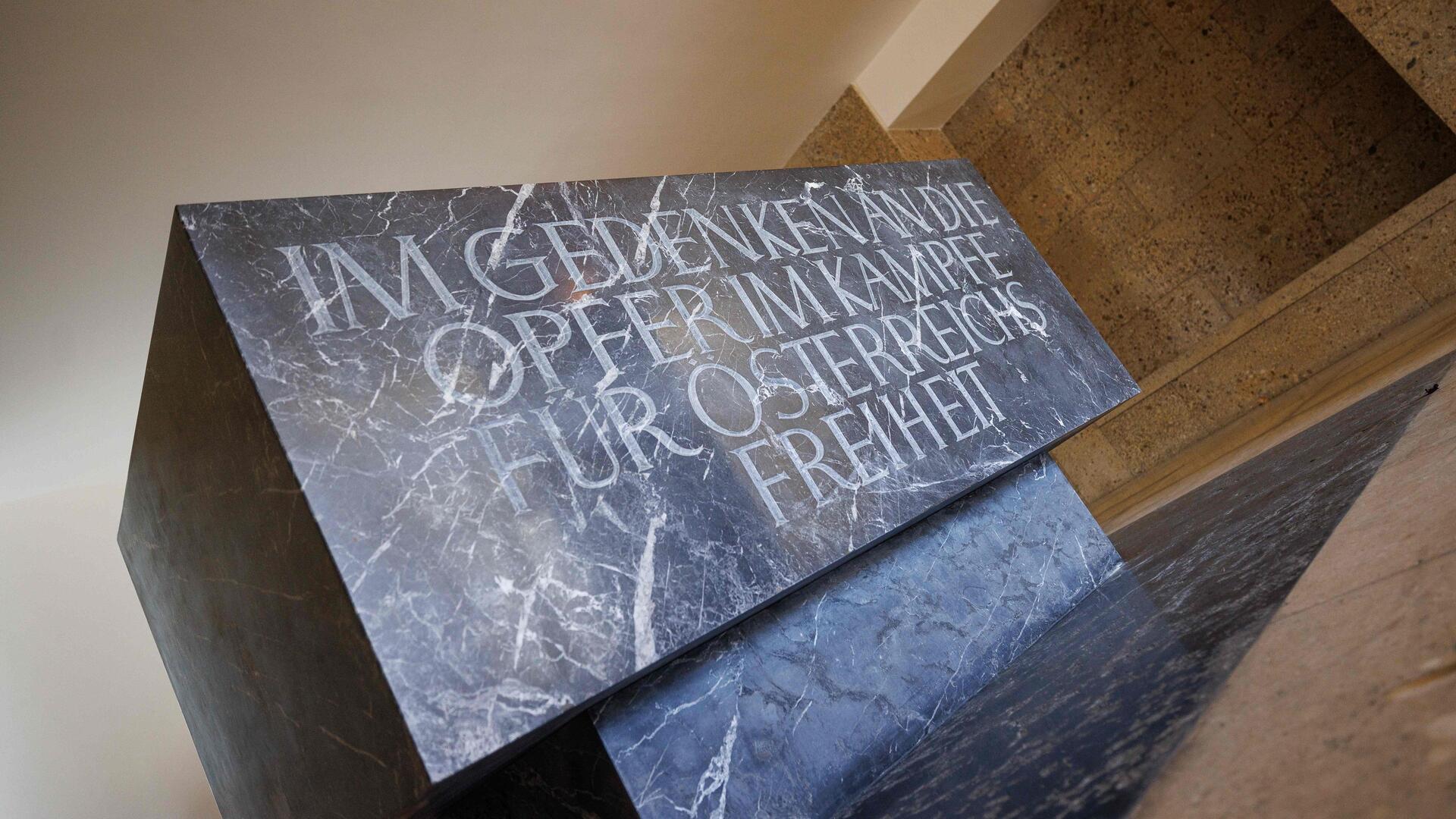
Since 1965, the left wing has housed the Weiheraum (lit. room of consecration) for the Victims in the Struggle for Austria’s Freedom against National Socialism. At its centre stands a marble block bearing the federal coat of arms and the inscription To the victims of the fight for Austria’s freedom. A display case in the entrance area highlights Nazi persecution, resistance, the restoration of the Republic, and the State Treaty. The Weiheraum forms a counterpoint to the crypt: a republican commemoration of freedom and resistance rather than a military commemoration of the fallen.
Above the gateway lies the Hall of Honour, which is open to the skies. It was also built in 1934 as part of the Heroes’ Memorial. Its decorative elements and inscriptions reflect a culture of military remembrance which draws on the traditions of the Habsburg Army. Since 2019, the monument to the Austrian Armed Forces of the Second Republic has also been located there. It commemorates the soldiers who have lost their lives in the line of duty since 1955.
The Äusseres Burgtor illustrates how memory comes into being and how it is interpreted or utilised at different times. A city gate became a heroes’ memorial; a site burdened by the military’s interpretation of sacrifice was transformed into a state memorial where war, National Socialism, resistance, the Republic, and responsibility remain visible. Its significance lies in this tension: the Burgtor not only calls for remembrance, but also for understanding. To this end, the Museum of Military History will contribute through curatorial interventions and develop the site as a museum.
The Museum of Military History offers educational programmes on the Äusseres Burgtor and its history upon request. Bookings can be made at kulturvermittlung@hgm.at.